
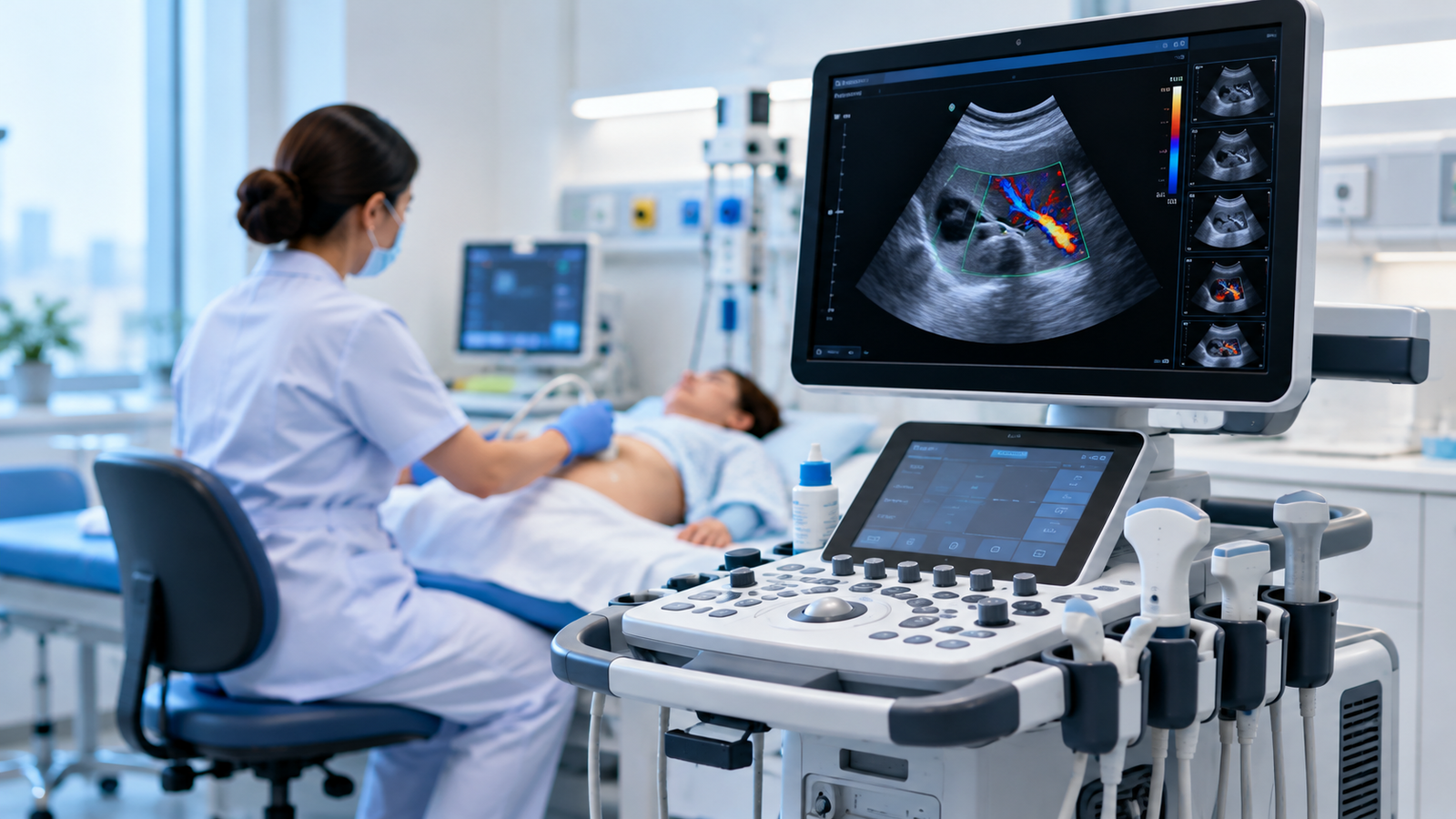
Ultrasound equipment is an essential part of diagnostic imaging in hospitals, specialist clinics and diagnostic centres. It uses high-frequency sound waves to produce images of internal structures, helping trained healthcare professionals examine organs, blood flow, soft tissues and developing pregnancies without using ionising radiation.
For healthcare organisations in Dubai, Abu Dhabi and across the UAE, choosing an ultrasound system involves more than comparing image resolution or purchase prices. Buyers need to assess clinical applications, transducer compatibility, imaging modes, workflow, connectivity, maintenance and regulatory documentation.
This guide explains the main types of ultrasound equipment, their applications, the differences between common imaging technologies and the practical considerations procurement teams should review before requesting a quotation.
Table of Contents
What Is Ultrasound Equipment?
Ultrasound equipment consists of an imaging system, one or more transducers and associated software and accessories used to acquire and display diagnostic ultrasound images.
A transducer, commonly called a probe, converts electrical energy into sound waves and receives returning echoes. The system processes those echoes to create images or other measurements that a qualified healthcare professional can interpret.
Unlike X-ray and CT imaging, diagnostic ultrasound does not use ionising radiation. However, it still requires appropriate operating practices, equipment maintenance and attention to acoustic output and examination duration.
The World Health Organization provides educational guidance on diagnostic ultrasound in its Manual of Diagnostic Ultrasound.
How an ultrasound system works
A typical examination follows several steps:
- The operator selects a suitable transducer and examination preset.
- Ultrasound waves travel into the body from the transducer.
- Returning echoes are detected and processed by the system.
- The monitor displays an image, Doppler information or other supported measurements.
- The operator adjusts settings and documents the examination according to the clinical workflow.
Image quality depends on multiple factors, including transducer frequency, tissue characteristics, scanning technique, system settings and the equipment’s capabilities.
Types of Ultrasound Equipment and Their Applications
Ultrasound systems vary according to their intended clinical applications, physical design and available imaging modes. Understanding these differences helps procurement teams select equipment that matches their departments’ requirements.
1. General-purpose ultrasound systems
General-purpose ultrasound machines are designed for a range of examinations, which may include abdominal, pelvic, superficial tissue and other applications depending on the model and installed software.
They are commonly considered by hospitals, multispecialty clinics and diagnostic centres that require flexibility across different examination types.
Before purchasing, assess the supported applications, available presets, compatible probes, image storage, reporting workflow and the ability to expand the system as clinical requirements change.
2. Colour Doppler ultrasound systems
Colour Doppler ultrasound displays information about blood flow by using Doppler techniques to assess motion. Depending on the system, other available modes may include spectral Doppler and power Doppler.
These capabilities can support vascular, cardiac, obstetric and other examinations when the relevant application is supported and the examination is performed by a suitably trained professional.
Buyers should verify which Doppler modes are included, the compatible transducers, available measurement tools and any additional software or licensing requirements. A product described as a colour Doppler system should not automatically be assumed to provide every Doppler function.
3. Obstetric and gynaecological ultrasound systems
Obstetric and gynaecological ultrasound systems are configured for examinations involving pregnancy and the female reproductive system.
Depending on the model, features may include obstetric measurement packages, fetal imaging presets, gynaecological applications, image storage and optional 3D or 4D imaging.
The term 4D ultrasound generally refers to three-dimensional imaging displayed over time. It is not a substitute for assessing the suitability of a system for a particular obstetric examination.
When evaluating equipment for a maternity department, consider the required examinations, transducer options, measurement and reporting tools, image documentation and relevant clinical protocols.
4. Cardiac ultrasound systems
Cardiac ultrasound, also known as echocardiography, uses ultrasound to assess the heart’s structures and function. Systems intended for this specialty may offer cardiac-specific presets, measurements, Doppler modes and compatible phased-array transducers.
Hospitals and cardiology centres should verify that the proposed configuration supports their intended examinations and clinical workflows.
Important considerations include image quality for cardiac applications, available Doppler measurements, ECG integration where required, reporting tools, data export and compatibility with the facility’s existing systems.
5. Portable ultrasound systems
Portable ultrasound machines are designed to be moved between examination rooms, departments or care locations. Depending on the model, they may provide general imaging, vascular assessment, cardiac imaging or other specialised applications.
Portable systems can be useful where space is limited or imaging is needed at different locations within a healthcare facility.
Check battery performance, weight, mobility, cleaning requirements, probe availability, screen visibility and the availability of the required imaging modes. Portability alone does not establish that a device is suitable for every point-of-care application.
6. Handheld ultrasound devices
Handheld ultrasound systems are compact devices that may connect to a compatible mobile device or operate with an integrated display. Their available capabilities vary considerably.
They can be considered for specific point-of-care examinations, clinical assessment and other applications supported by the manufacturer’s intended-use documentation.
Before purchasing, confirm supported examination types, compatible phones or tablets if applicable, software requirements, image storage, cybersecurity controls, battery operation and the cost of subscriptions or additional features.
7. Specialised ultrasound systems
Some systems are designed primarily for particular specialties, such as urology, vascular imaging or musculoskeletal assessment.
Specialised configurations may offer dedicated probes, presets, measurement tools and workflow features. The appropriate choice depends on the clinical service being delivered, not simply on the number of features advertised.
ZabMed’s ultrasound equipment category lists several system types, including portable, multispecialty, obstetric, cardiac and urology ultrasound equipment. Confirm the current availability and specifications of each product directly with the supplier.
Understanding Ultrasound Imaging Modes and Transducers
The imaging mode and probe determine what information a system can produce. Both should be assessed against the examinations the facility expects to perform.
2D, 3D and 4D ultrasound
2D ultrasound produces conventional two-dimensional images and is widely used for diagnostic examinations across multiple specialties.
3D ultrasound reconstructs a three-dimensional representation from acquired ultrasound data when supported by the system and transducer.
4D ultrasound displays three-dimensional imaging over time, allowing the operator to observe changes dynamically.
These capabilities are not interchangeable, and not every system supports all three. Buyers should assess the actual clinical applications, transducer requirements, image quality and workflow rather than selecting equipment based on the mode name alone.
Common ultrasound transducers
| Transducer type | Typical applications |
|---|---|
| Convex or curvilinear | Abdominal and many obstetric examinations |
| Linear array | Superficial structures, vascular imaging and musculoskeletal examinations |
| Phased array | Cardiac imaging and selected examinations requiring a smaller contact footprint |
| Endocavitary | Selected transvaginal or transrectal examinations, subject to intended use |
| Specialised probes | Specific applications supported by the system and manufacturer |
These are general examples, not universal rules. The required probe frequency, footprint, imaging depth and compatibility depend on the clinical application and the individual device.
Before placing an order, obtain a list of included transducers and identify any additional probes needed for the planned services.
Key Features to Evaluate Before Buying Ultrasound Equipment
A structured technical evaluation helps procurement teams compare systems on clinically relevant criteria.
Image quality and processing
Assess the image quality demonstrated for the intended applications. Review available imaging modes, image processing options, presets, measurement tools and the ease of adjusting settings during an examination.
Where practical, arrange a product demonstration using representative clinical scenarios and compatible transducers. Do not rely on a single headline specification to determine overall image quality.
Workflow and usability
Consider control layout, touchscreen functionality, monitor size, keyboard or control-panel design, preset selection, patient data entry and report generation.
For a busy diagnostic centre, a workflow that supports consistent examinations and efficient documentation may be more useful than features that are rarely used by the department.
Connectivity and image management
Some ultrasound systems support integration with Picture Archiving and Communication Systems (PACS), Radiology Information Systems (RIS) or other hospital platforms.
Confirm the available interfaces, supported standards, software versions, storage options and integration costs. Ask the facility’s IT team to assess network security, access controls, data retention and any applicable privacy obligations.
Do not assume that every system advertised as network-ready is compatible with every hospital information system.
Ergonomics and operating environment
Assess the height and adjustability of the console, display positioning, cable management, mobility and available storage. Check electrical requirements, room layout and any installation conditions specified by the manufacturer.
For portable systems, evaluate transport, battery operation and cleaning requirements. For fixed installations, verify the available space and any infrastructure requirements before delivery.
How UAE Healthcare Facilities Should Approach Procurement
Hospitals, clinics and diagnostic centres in the UAE should assess ultrasound equipment against their intended clinical use, documentation requirements and long-term operating needs.
Verify regulatory and technical documentation
Before purchase, confirm the applicable UAE medical-device registration, importation and conformity requirements for the specific device and supply arrangement.
The UAE Ministry of Health and Prevention provides official information on healthcare and medical-device services. Buyers should verify current requirements directly with the relevant authority rather than relying solely on general supplier statements.
Request product-specific documentation as applicable, including the manufacturer’s instructions for use, technical specifications, declarations of conformity, registration evidence and traceability information.
Do not assume that a supplier’s general certification or a product’s marketing description establishes compliance with every requirement.
Plan maintenance, servicing and training
Ultrasound systems require appropriate care throughout their operating life. Procurement teams should establish the manufacturer’s recommended maintenance arrangements and the facility’s own equipment-management procedures.
Before signing a purchase agreement, clarify:
- Warranty duration, scope and exclusions
- Preventive maintenance and performance checks
- Availability of technical support and replacement parts
- Transducer inspection, care and replacement arrangements
- Software updates and any recurring licence costs
- User training and technical documentation
- Service response arrangements and repair turnaround
Transducers deserve particular attention because damage, improper handling or incompatible cleaning products can affect their condition and performance.
Follow appropriate ultrasound safety practices
Diagnostic ultrasound does not use ionising radiation, but this does not mean that equipment can be operated without appropriate precautions.
Operators should follow the manufacturer’s instructions, use suitable examination settings, maintain appropriate exposure duration and follow relevant clinical guidance. Staff training and equipment maintenance are essential parts of a responsible ultrasound programme.
The American Institute of Ultrasound in Medicine’s practice parameters provide examination-specific guidance for healthcare professionals. These resources support clinical practice but do not replace applicable UAE requirements or professional judgement.
Common Ultrasound Procurement Mistakes
Healthcare buyers can reduce avoidable costs and operational difficulties by addressing several common issues before purchasing.
Choosing by price alone: A low initial price may not include all the probes, software, accessories, training or service coverage required.
Overlooking transducer compatibility: Not every probe works with every ultrasound system. Confirm supported models and connectors.
Paying for unnecessary features: Select capabilities based on the facility’s actual clinical services and planned expansion.
Underestimating integration requirements: PACS, RIS or other system integration may require additional software, licences, configuration and technical work.
Ignoring serviceability: Clarify warranty coverage, transducer repair options, replacement availability and preventive maintenance requirements.
Assuming all ultrasound systems support 3D, 4D or Doppler: These capabilities depend on the specific system, probe and software configuration.
Failing to assess the user workflow: A technically capable system may still be unsuitable if its ergonomics, reporting process or mobility do not match the department’s needs.
How to Evaluate an Ultrasound Equipment Supplier
A suitable supplier should help the buyer establish a clear technical and commercial specification.
Evaluate potential suppliers against these criteria:
- Product suitability: Does the proposed system match the clinical specialty and examination requirements?
- Specification transparency: Are the exact model, transducers, software and included accessories listed?
- Documentation: Can the supplier provide the relevant product and regulatory documents?
- Quotation clarity: Are installation, training, delivery, warranty and optional costs explained?
- After-sales arrangements: Are maintenance, repairs and replacement parts addressed?
- Technical coordination: Can the supplier work with the facility’s biomedical engineering and IT teams when needed?
- Supply planning: Are delivery lead times and any configuration dependencies stated clearly?
A useful procurement specification should define the clinical application, required imaging modes, transducers, data interfaces, accessories, service expectations and budget. This makes it easier to compare equivalent offers.
How ZabMed Can Help B2B Healthcare Buyers
ZabMed provides a dedicated ultrasound equipment category for healthcare organisations exploring diagnostic imaging systems. The category includes several types of ultrasound products, such as portable scanners, multispecialty systems and specialty-focused configurations.
For hospitals, clinics and diagnostic centres, the next step is to define the intended use and request product-specific details before choosing a system.
When contacting ZabMed, procurement teams can prepare the following information:
- Medical specialty and intended examinations
- Required imaging modes, including Doppler or 3D/4D where needed
- Preferred transducer types and quantities
- Portable or console-based system preference
- Image storage and hospital-system integration requirements
- Installation location and anticipated usage
- Training, maintenance and warranty expectations
- Quantity, delivery location and quotation requirements
ZabMed’s product catalogue provides access to additional medical equipment categories, while the contact page is the appropriate starting point for a product enquiry.
Product availability, technical specifications, included accessories, regulatory status and service arrangements should be confirmed for the exact model being considered. This helps ensure that a quotation reflects the facility’s actual requirements.
Frequently Asked Questions
What is ultrasound equipment used for?
Ultrasound equipment produces diagnostic images using high-frequency sound waves. Depending on the system and transducer, it can support abdominal, obstetric, gynaecological, cardiac, vascular, musculoskeletal and other examinations.
What is the difference between 2D, 3D and 4D ultrasound?
2D ultrasound produces flat, two-dimensional images. 3D ultrasound reconstructs a three-dimensional representation, while 4D ultrasound displays three-dimensional imaging over time. Availability depends on the system, transducer and supported software.
Which ultrasound machine is suitable for a diagnostic centre?
The appropriate system depends on the centre’s specialties, examination volume, required imaging modes, probe selection, reporting workflow and integration needs. A multispecialty centre may need a different configuration from a cardiology or obstetric clinic.
What should I check before buying ultrasound equipment in the UAE?
Verify the intended use, technical specifications, transducer compatibility, applicable regulatory documentation, included accessories, warranty, maintenance, training and integration requirements. Confirm the current regulatory position for the exact device and supply arrangement.
Are portable ultrasound machines suitable for hospitals?
Portable systems can support selected examinations in different departments or care locations. Suitability depends on the intended clinical application, imaging capabilities, compatible probes, battery performance and workflow requirements.
How should ultrasound equipment be maintained?
Follow the manufacturer’s instructions for cleaning, transducer care, inspection, servicing and software maintenance. The healthcare facility should document appropriate checks and arrange repairs or preventive maintenance according to the manufacturer’s guidance and its equipment-management procedures.
Conclusion
Ultrasound equipment supports diagnostic imaging across a wide range of clinical specialties. Selecting the right system requires a clear understanding of intended examinations, imaging modes, transducer compatibility, workflow, data integration, maintenance and regulatory documentation.
For healthcare providers in Dubai, Abu Dhabi and across the UAE, a structured procurement process helps align equipment capabilities with clinical requirements and long-term operational needs.
Explore the ultrasound equipment range at ZabMed.ae and prepare your clinical and technical requirements before requesting a quotation. Confirm the exact product configuration, availability and applicable documentation with the supplier before making a purchasing decision.