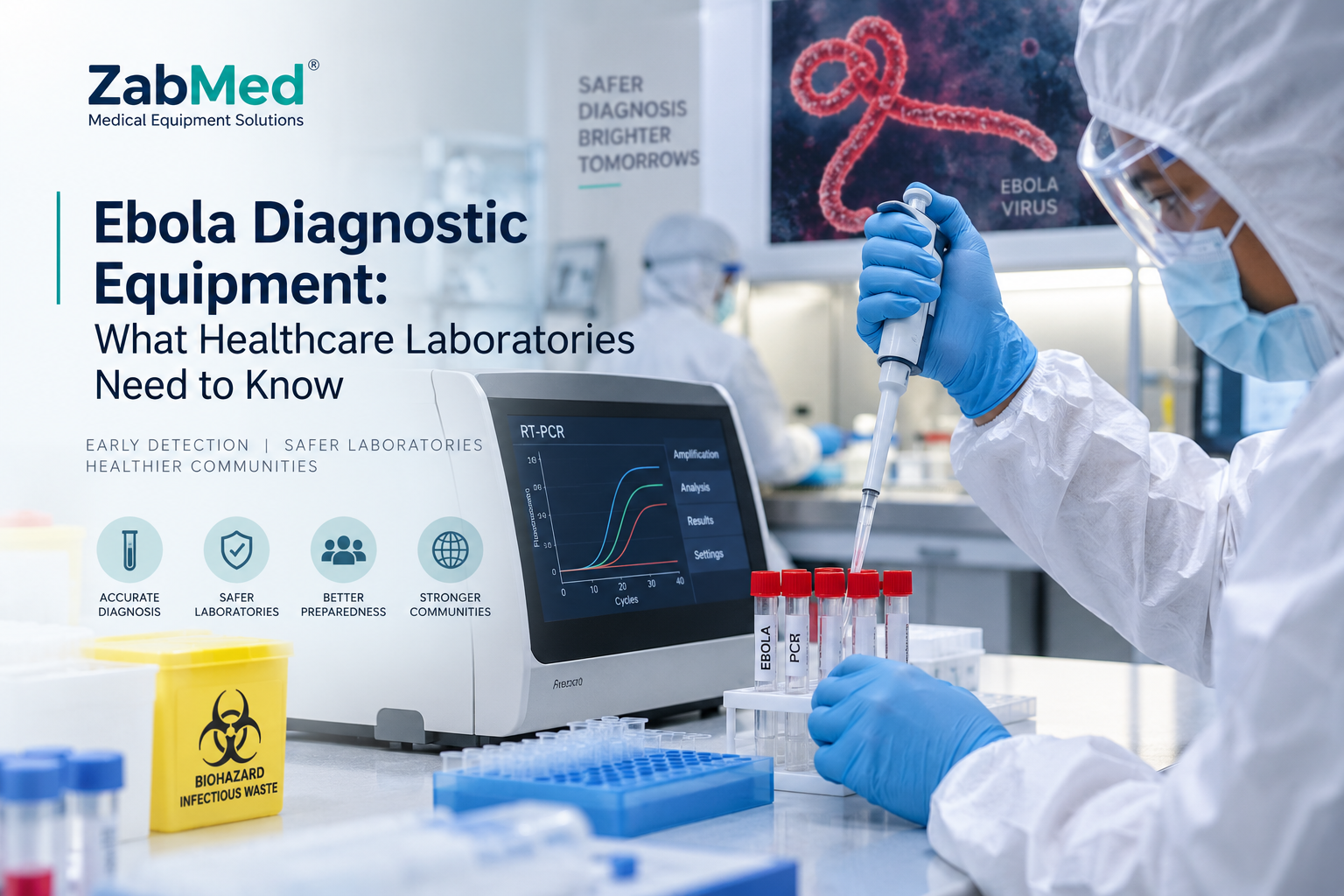
When a serious infectious disease such as Ebola is suspected, early and accurate diagnosis can make an important difference. Rapid confirmation helps healthcare teams provide appropriate patient care, implement infection prevention measures, and support public-health measures to prevent further transmission.
However, diagnosing Ebola is not as simple as using a single machine or laboratory test. It requires a combination of validated diagnostic methods, appropriate laboratory equipment, safe specimen handling, trained professionals, biosafety procedures, and reliable quality systems.
The World Health Organization’s latest diagnostic testing guidance for Ebola and Marburg virus diseases, published in July 2026, emphasizes that rapid diagnosis is critical for timely and appropriate care and for stopping transmission. It also highlights the importance of appropriate biosafety measures when handling specimens from suspected cases.
For healthcare facilities and laboratories in the UAE, understanding these requirements can help with better preparedness and more informed decisions when planning laboratory infrastructure.
ZabMed supplies medical and laboratory equipment to hospitals, clinics, laboratories, and research facilities across the UAE. Through its laboratory equipment solutions, ZabMed provides equipment across clinical diagnostics, microbiology, research, and quality-control applications, along with product guidance and installation support.
Table of Contents
Why Is Early Ebola Diagnosis Important?
Ebola can initially look like several other infectious diseases. Fever, headache, weakness, fatigue, vomiting, diarrhea, and other symptoms may also occur with conditions such as malaria and other infections.
This makes it difficult to confirm Ebola based on symptoms alone.
Laboratory testing is therefore an important part of evaluating a suspected case. WHO states that rapid diagnosis is important not only for providing appropriate care but also for preventing further transmission.
Early diagnosis can allow healthcare teams to:
- Begin appropriate supportive care sooner
- Monitor the patient’s condition closely
- Apply appropriate infection-prevention measures
- Protect healthcare workers and other patients
- Support contact tracing and outbreak investigations
- Determine whether specific treatments or vaccines are relevant to the virus involved
It is important to clarify that early detection does not mean that Ebola can automatically be cured. Rather, early diagnosis allows healthcare professionals to identify the infection sooner and begin appropriate care and public-health measures.
WHO notes that early intensive supportive care can improve survival in Ebola disease.
How Is Ebola Diagnosed?
Ebola diagnosis requires laboratory testing performed using appropriate methods and safety procedures.
According to WHO, diagnostic methods for orthoebolavirus infections can include:
- Reverse transcription polymerase chain reaction (RT-PCR)
- Antibody-capture enzyme-linked immunosorbent assay (ELISA)
- Antigen-capture detection tests
- Virus isolation by cell culture
The choice of test depends on factors such as the suspected virus, stage of illness, available laboratory capacity, and applicable diagnostic guidance.
RT-PCR Testing
RT-PCR is an important molecular diagnostic method for detecting viral genetic material.
In simple terms, the test looks for genetic material from the virus in a patient’s specimen. Molecular testing has become an important part of modern infectious-disease diagnosis.
WHO’s diagnostic guidance emphasizes the importance of appropriate molecular testing and validated diagnostic assays when evaluating suspected Ebola disease.
Antigen Detection
Antigen-based tests detect specific viral components, rather than directly detecting the virus’s genetic material.
Rapid antigen tests may have a role in certain settings, particularly where laboratory infrastructure is limited, but their performance and limitations must be understood. WHO has published specific guidance on the selection and use of Ebola in vitro diagnostic assays and rapid antigen tests.
Serological Testing
Antibody-based testing can also play a role in certain circumstances, including investigations involving immune responses and previous infection.
The appropriate test depends on the clinical and public-health context. Laboratories should therefore follow current national and international guidance rather than selecting a test based solely on availability.
What Equipment Is Needed for Ebola Diagnostic Testing?
One of the most common misconceptions is that an Ebola laboratory simply needs a PCR machine.
In reality, a safe diagnostic workflow may involve multiple pieces of laboratory equipment and infrastructure, depending on the testing method, laboratory design, risk assessment, and local regulations.
Potential equipment and infrastructure can include:
1. Real-Time PCR Systems
For laboratories performing molecular testing, an appropriate real-time PCR platform may be required.
The PCR instrument itself is only one part of the testing workflow. Laboratories also need compatible assays, reagents, controls, sample-preparation procedures, trained personnel, appropriate software, and quality-control processes.
WHO’s technical documentation on Ebola diagnostic assays has historically identified real-time PCR platforms among the equipment used with molecular Ebola testing workflows.
2. Biosafety Cabinets
Biosafety cabinets can provide an important layer of protection when laboratory personnel are working with potentially infectious specimens.
Current WHO diagnostic guidance recommends a risk-based approach to handling specimens from suspected Ebola and Marburg disease cases. For certain procedures involving specimens that have not been inactivated, WHO describes heightened containment measures, including appropriate biosafety cabinets or gloveboxes depending on the laboratory’s circumstances and risk assessment.
A biosafety cabinet should not be treated as a standalone solution. Its suitability depends on the work being performed, laboratory design, certification, maintenance, airflow requirements, and applicable biosafety procedures.
3. Centrifuges
Centrifuges can be used in laboratory workflows for sample preparation and separation.
However, when potentially infectious specimens are involved, centrifugation must be considered as part of the overall biosafety risk assessment.
WHO’s laboratory biosafety guidance emphasizes that equipment used in containment workflows needs to be compatible with the laboratory’s safety controls and procedures.
For laboratories reviewing their general sample-preparation requirements, ZabMed’s laboratory equipment range includes centrifuges and other precision instruments used across laboratory applications.
4. Micropipettes and Liquid-Handling Equipment
Accurate liquid handling is fundamental to many molecular and laboratory testing workflows.
Depending on the diagnostic method, laboratories may require appropriately calibrated micropipettes and related laboratory accessories.
Equipment selection should consider:
- Required volume ranges
- Accuracy and precision
- Compatibility with laboratory workflows
- Ease of cleaning and decontamination
- Calibration requirements
- Maintenance and service availability
5. Vortex Mixers
Vortex mixers may be used for appropriate sample and reagent preparation steps in laboratory workflows.
As with other laboratory equipment, the suitability of a vortex mixer depends on the specific procedure being performed and the laboratory’s biosafety risk assessment.
6. Refrigeration and Sample Storage
Laboratories may require controlled-temperature storage for certain reagents, controls, and specimens.
The appropriate storage temperature depends on the specific material and diagnostic protocol.
Laboratories should follow the manufacturer’s instructions for reagents and the relevant diagnostic procedure rather than applying one storage condition to every Ebola-related specimen or reagent.
7. Laboratory Incubators and Other Support Equipment
Depending on the laboratory’s broader activities, equipment such as incubators, balances, drying ovens, mixers, and other laboratory instruments may be required for general clinical, microbiology, research, or quality-control workflows.
These instruments are not necessarily Ebola-specific diagnostic equipment. This distinction is important.
For example, a laboratory centrifuge can support many different laboratory processes, but that does not mean the centrifuge itself detects Ebola.
Biosafety Is Just as Important as Diagnostic Equipment
Having modern laboratory equipment is not enough to create a safe Ebola diagnostic laboratory.
Biosafety must be built into the entire workflow.
WHO’s July 2026 diagnostic guidance states that specimens from suspected Ebola or Marburg disease cases must be handled using appropriate biosafety measures. It recommends a risk-based approach and emphasizes trained personnel, appropriate procedures, personal protective equipment, and suitable containment measures.
Laboratories should consider:
- Specimen collection
- Specimen transportation
- Specimen reception
- Sample inactivation where applicable
- Sample preparation
- Diagnostic testing
- Waste management
- Spill response
- Decontamination
- Equipment maintenance
- Staff training
- Emergency procedures
The WHO Laboratory Biosafety Manual provides broader guidance on applying a risk-based approach to laboratory biosafety. WHO emphasizes that biosafety measures should be selected according to the hazards and activities involved rather than relying on a single universal laboratory setup.
Personal Protective Equipment for Laboratory Personnel
Laboratory workers handling potentially infectious specimens require appropriate personal protective equipment based on the risk assessment and procedure being performed.
Depending on the task and applicable protocols, PPE may include:
- Gloves
- Protective gowns or coveralls
- Eye and face protection
- Respiratory protection
- Appropriate footwear or shoe coverings
The exact PPE requirements should be determined by trained professionals according to current national and international guidance.
WHO’s current diagnostic guidance emphasizes that personnel must be trained and competent in tasks such as PPE use, specimen handling, sample processing, decontamination, and waste management.
What Does a Safe Ebola Laboratory Workflow Look Like?
A laboratory’s Ebola diagnostic workflow should be carefully planned from beginning to end.
A simplified workflow may look like:
Patient assessment
↓
Suspected Ebola case identified
↓
Appropriate specimen collected
↓
Safe packaging and transport
↓
Specimen received by appropriately equipped laboratory
↓
Risk-based specimen handling
↓
Diagnostic testing
↓
Result interpretation and reporting
↓
Clinical and public-health response
Every stage matters.
A high-quality PCR instrument cannot compensate for poor specimen handling. Similarly, excellent PPE cannot compensate for inadequate staff training or an unsuitable laboratory workflow.
This is why WHO’s current guidance addresses the entire diagnostic process, from specimen collection through diagnostic analysis and reporting.
Why Laboratory Equipment Selection Matters
Laboratory managers should look beyond the purchase price when selecting equipment.
For infectious-disease and diagnostic laboratories, important considerations may include:
Accuracy and Reliability
Equipment should perform consistently and meet the requirements of the intended laboratory procedure.
Compatibility
Different instruments, consumables, software, and accessories need to work together properly.
Safety
Equipment should be suitable for the laboratory’s risk controls and workflow.
Maintenance
Laboratories should consider calibration, preventive maintenance, repairs, spare parts, and technical support.
Availability of Support
A laboratory may depend on equipment every day. Reliable installation and after-sales support can therefore be important when selecting a supplier.
Staff Training
Laboratory personnel should understand how to operate equipment safely and correctly.
Regulatory and Quality Requirements
Laboratories must follow applicable national regulations, quality-management requirements, manufacturer instructions, and diagnostic protocols.
Choosing Laboratory Equipment for Infectious-Disease Preparedness
Healthcare facilities do not necessarily need to purchase equipment specifically labelled “Ebola equipment.”
Instead, laboratory managers should assess the entire diagnostic workflow and determine which equipment is required for the procedures their facility is authorized and prepared to perform.
Questions to consider include:
- What diagnostic tests will the laboratory perform?
- Which viruses or pathogens need to be detected?
- What specimen types will be handled?
- What biosafety controls are required?
- Does the facility have appropriate containment infrastructure?
- Which instruments are compatible with the selected diagnostic assays?
- What calibration and maintenance are required?
- Is technical support available locally?
- Are laboratory personnel appropriately trained?
- What are the national regulatory requirements?
This approach is more useful than simply purchasing individual instruments without considering the laboratory’s overall workflow.
How Can ZabMed Help Healthcare and Laboratory Facilities?
For UAE healthcare organizations, finding suitable laboratory equipment is only one part of the procurement process.
Facilities may also need help evaluating equipment specifications, compatibility, installation requirements, maintenance, and ongoing support.
ZabMed supplies medical and diagnostic equipment to hospitals, clinics, laboratories, and research facilities across the UAE. Its laboratory range includes equipment for clinical diagnostics, microbiology, research, and quality-control applications.
ZabMed’s laboratory equipment offering includes products such as:
- Centrifuges
- Balances
- Magnetic stirrers
- Drying ovens
- Incubators
- Pipettes
- Other laboratory and precision instruments
The company also provides product guidance, installation assistance, and after-sales support.
If your laboratory is planning an equipment upgrade or reviewing its diagnostic infrastructure, explore ZabMed’s laboratory equipment solutions to see the range of equipment available for UAE laboratories.
Importantly, ZabMed equipment should not be presented as an Ebola treatment or as automatically suitable for Ebola testing. The specific suitability of any equipment for infectious-disease diagnostic work depends on the intended procedure, laboratory design, applicable biosafety requirements, validated assays, and regulatory requirements.
Why Equipment Alone Cannot Guarantee Accurate Ebola Diagnosis
It is important to understand that buying sophisticated equipment does not automatically create diagnostic capability.
Accurate diagnosis depends on several elements working together:
Validated test + appropriate specimen + trained personnel + suitable equipment + proper laboratory workflow + quality control + biosafety
If one of these elements is inadequate, the reliability or safety of the overall process may be affected.
WHO recommends using diagnostic assays that have undergone appropriate assessment of quality, safety, and performance.
For this reason, laboratories should select equipment based on the diagnostic methods they intend to use and the requirements of those methods.
The Importance of Quality Control and Equipment Maintenance
Laboratory equipment needs to remain reliable after installation.
Regular maintenance and appropriate quality-control procedures can help laboratories identify equipment problems before they affect routine work.
Depending on the instrument, laboratories may need to consider:
- Calibration
- Preventive maintenance
- Performance verification
- Cleaning
- Replacement of consumables
- Software updates
- Service records
- Equipment qualification
- Staff competency
The exact requirements vary by equipment type and laboratory procedure.
Laboratories should follow manufacturer instructions, applicable quality standards, and their own validated procedures.
Why Trained Laboratory Personnel Matter
Even the best laboratory equipment requires skilled people to operate it.
Personnel involved in Ebola-related diagnostic work may need training in:
- Specimen handling
- PPE
- Biosafety
- Sample preparation
- Diagnostic procedures
- Equipment operation
- Waste management
- Decontamination
- Spill response
- Result reporting
WHO’s current diagnostic guidance specifically emphasizes that personnel handling potentially infectious specimens should be trained and assessed as competent in the procedures they perform.
This is why equipment procurement, laboratory design, training, and biosafety planning should be considered together.
Ebola Diagnostic Equipment: Key Takeaways
Ebola diagnosis requires much more than a single laboratory instrument.
The most important points for healthcare laboratories are:
- Early diagnosis is important for timely patient care and outbreak control.
- Ebola can be difficult to distinguish from other infectious diseases based on symptoms alone.
- Laboratory confirmation may involve methods such as RT-PCR, antigen detection, and antibody-based testing.
- Potentially infectious specimens require appropriate biosafety measures.
- Diagnostic laboratories need suitable equipment, infrastructure, procedures, and trained personnel.
- Real-time PCR systems can be important components of molecular diagnostic workflows, but the appropriate platform depends on the validated assay and laboratory requirements.
- Centrifuges, pipettes, vortex mixers, storage equipment, and other instruments may support laboratory workflows but are not themselves Ebola-specific diagnostic tests.
- Equipment must be compatible with the laboratory’s safety controls and intended procedures.
- Maintenance, calibration, quality control, and staff training are essential parts of laboratory reliability.
- Healthcare facilities should select equipment based on their actual diagnostic workflow rather than simply purchasing individual instruments.
- ZabMed supplies medical and laboratory equipment to healthcare and research facilities across the UAE and provides product guidance and installation support.
Frequently Asked Questions
What equipment is used to diagnose Ebola?
Ebola diagnostic laboratories may use equipment such as real-time PCR systems, appropriate biosafety cabinets or containment equipment, centrifuges, micropipettes, vortex mixers, and temperature-controlled storage, depending on the diagnostic method and laboratory setup.
The exact equipment required depends on the validated assay, specimen workflow, biosafety risk assessment, and applicable regulations.
Is a PCR machine enough to diagnose Ebola?
No.
A PCR instrument is only one component of a molecular diagnostic workflow. Accurate diagnosis also requires an appropriate validated assay, suitable specimens, trained personnel, controls, quality procedures, and appropriate biosafety measures.
Can a normal laboratory test for Ebola?
Not necessarily.
Testing potentially infectious Ebola specimens requires appropriate biosafety measures, trained personnel, and suitable laboratory facilities. Laboratories without the necessary capacity may need to refer specimens to designated facilities according to national and public-health procedures.
Is a biosafety cabinet required for Ebola testing?
The required containment and biosafety controls depend on the specific procedure, specimen condition, laboratory design, and risk assessment.
Current WHO guidance describes heightened control measures for handling non-inactivated specimens, including appropriate biosafety cabinets or gloveboxes depending on the circumstances.
Does ZabMed sell Ebola testing machines?
ZabMed supplies a range of laboratory and diagnostic equipment, including centrifuges, incubators, pipettes, and other laboratory instruments.
However, whether a particular instrument is suitable for an Ebola diagnostic workflow depends on the validated diagnostic assay, laboratory biosafety requirements, and applicable regulations. Equipment should not be described as an Ebola diagnostic device unless it is specifically validated and authorized for that purpose.
Why is early Ebola detection important?
Early diagnosis can help healthcare professionals begin appropriate care, implement infection-control measures, and support public-health measures such as contact tracing. WHO identifies rapid diagnosis as critical for timely care and stopping transmission.
Final Thoughts
Ebola preparedness is not simply about purchasing advanced laboratory equipment. A safe and effective diagnostic system requires appropriate testing methods, reliable equipment, biosafety infrastructure, trained personnel, quality control, and well-designed laboratory workflows.
For healthcare facilities, laboratories, and research organizations in the UAE, working with an experienced medical and laboratory equipment supplier can make the equipment-selection process easier.
ZabMed helps UAE laboratories and healthcare facilities source laboratory and diagnostic equipment, with support for product selection, installation, and ongoing service.
Explore ZabMed’s laboratory equipment solutions to learn more about the equipment available for modern laboratory environments.
Medical and Technical Disclaimer
This article is intended for general educational purposes and does not provide instructions for diagnosing, handling, or testing Ebola specimens outside an appropriately equipped and authorized laboratory.
Ebola diagnostic testing involves potentially infectious specimens and should only be performed by appropriately trained personnel using validated diagnostic methods, appropriate biosafety controls, and applicable national and international guidance.
For the most current recommendations, laboratories should consult the WHO’s latest Ebola and Marburg diagnostic testing guidance and applicable guidance from their national public-health and regulatory authorities.